Technologist's guide · Core drilling
Dry or wet core bitMaterial, dust and segment life.
The mode is decided by the material and the core bit, not by habit. Reinforced concrete, concrete and stone are drilled wet – water cools the segments, flushes out the cuttings and binds the silica dust; the standard is a core drill with a 1 1/4" UNC thread. Masonry, brick, hollow blocks and aerated concrete are usually drilled dry – with a dry core bit, most often M16, in a range of about Ø 32–162 mm, with dust extraction and no hammer action. Porcelain and tiles – an M14 core bit on an angle grinder. A wet core bit is not used dry: the segments overheat and can come off.
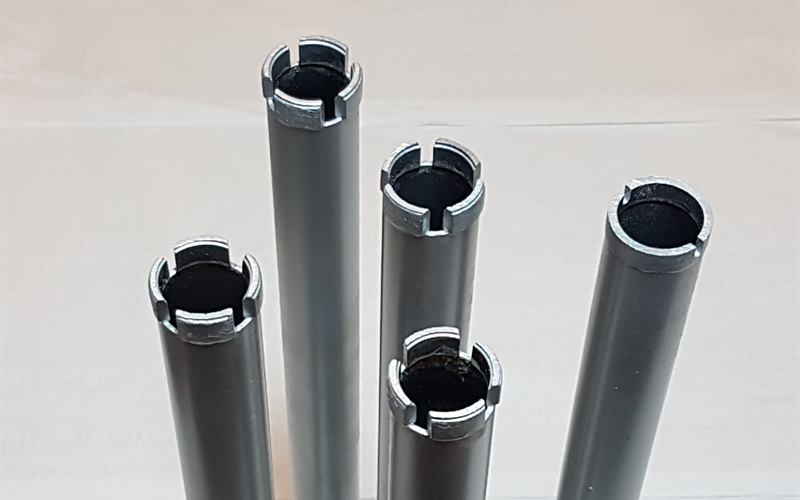
The key points in 30 seconds
- Wet: reinforced concrete, concrete, natural stone, core sampling – 1 1/4" UNC or 1/2" BSP thread.
- Dry: masonry, brick, hollow blocks, aerated concrete – M16 core bit, usually up to Ø 162 mm, with dust extraction.
- Electrical boxes: Ø 68 and 82 mm dry, M16 + SDS-plus, rotary hammer with hammer action off.
- Porcelain and tiles: M14 core bit on an angle grinder, dry or with cooling.
- Do not swap modes: a “wet” core bit used dry overheats and loses segments.
Which materials dry and which wet?
| Material | Mode | Mounting | Machine |
|---|---|---|---|
| Reinforced concrete, concrete | wet | 1 1/4" UNC (small diameters 1/2" BSP) | handheld or rig-mounted core drill |
| Natural stone, granite | wet | 1 1/4" UNC or 1/2" BSP | rig-mounted core drill |
| Core sampling (concrete, asphalt) | wet | 1 1/4" UNC | rig-mounted core drill |
| Brick, clay hollow blocks | dry | M16 | handheld dry core drill |
| Aerated concrete, blocks | dry | M16 | handheld dry core drill |
| Boxes in masonry and plaster | dry | M16 + SDS-plus | rotary hammer, hammer action off |
| Porcelain, tiles | dry or with cooling | M14 | angle grinder |
Treat masonry with concrete elements (ring beams, lintels, posts) as concrete – if the hole passes through a reinforced concrete ring beam, you need a wet core bit. Check your machine’s thread in the guide how to match a core bit to a core drill.
Drilling mode calculator
Choose the material, diameter and workplace. We will suggest the mode, mounting, machine and what to keep in mind on site.
Wet drilling – what does the water do and how much do you need?
- Cools the segmentsThe diamond and bond work at temperatures they could not withstand without cooling – especially when they meet reinforcing steel.
- Flushes out the cuttingsThe slurry flows out through the gap between the tube and the hole wall. Without water the cuttings stay in the gap, friction rises and the core bit jams.
- Binds the dustWet cuttings do not become airborne – the most effective way to limit silica dust from concrete.
- How much water? Enough for cloudy slurry to flow out of the hole all the time. A thick paste or steam at the bit means too little water. The flow must be continuous from starting the hole to breaking through.
- Slurry and interiors. In finished rooms collect the water with a water collection ring and a wet vacuum, and protect the floor and services. Do not pour the slurry into the drains – it settles in the pipes.
- Power and water. Wet core drills usually have a residual current device in the cable (PRCD). Test it before work and keep the cable away from water.
- Slab from below. Water runs down the bit onto the drill and the operator – without a collection ring such drilling is unpleasant and dangerous. More on drilling slabs: removing the core in a slab.
Dry drilling – how not to burn out the core bit?
- Only a dry core bit. It has a bond and segments designed to work without water and usually an M16 mounting – in a range of about Ø 32–162 mm. For electrical boxes: Ø 68 and 82 mm with an SDS-plus adapter.
- No hammer action. Switch the rotary hammer to rotation only – hammer action breaks segments and damages the adapter thread.
- Withdraw every few centimetres. A short withdrawal lets the cuttings fall out and cools the segments. In deeper holes remove the cuttings from the tube.
- Moderate pressure. Dry segments overheat more easily – too much pressure means a discoloured tube, glazed segments and slower progress.
- Dust extraction. Drill with extraction connected to an industrial vacuum with a suitable filter class – usually M or H – and use respiratory protection.
Silica dust – why concrete is drilled wet
Concrete, brick, stone and ceramics contain quartz. Dry drilling produces respirable crystalline silica dust – work involving exposure to it is listed in the EU as carcinogenic work (Directive 2017/2398), with a binding limit of 0.1 mg/m³ for the respirable fraction; some countries set lower national limits. When drilling concrete dry this value is easily exceeded.
That is why the rule “concrete wet” is not only about core bit life but also about the operator’s health. When drilling masonry dry, protective measures – extraction, vacuum, respiratory protection – are chosen according to the workplace risk assessment. More on dust when cutting: cut-off saw blade – dry or wet.
Mistakes that shorten core bit life
| Mistake | Effect | What to do |
|---|---|---|
| “Wet” core bit used dry | overheating, glazing, lost segment | always with water in concrete |
| Too little water | jamming, discoloured tube, rapid wear | continuous flow, cloudy slurry from the hole |
| Masonry core bit in reinforced concrete | breakouts on rebar, overheating | wet core bit for reinforced concrete |
| Hammer action on | broken segments, damaged thread | rotation only |
| Dry drilling without breaks | overheated segments, slower progress | withdraw every few centimetres |
A smooth, shiny segment that has stopped drilling is glazing – the result of a bond too hard for the material or overheating. We cover diagnosis by segment appearance in the problems and wear diagnosis guide, and jamming in the answer why does a core bit jam.
Dry or wet – questions and answers
Dry or wet core bit?
It depends on the material. Reinforced concrete, concrete and stone are drilled wet – water cools the segments, flushes out the cuttings and binds the dust. Masonry, brick, hollow blocks and aerated concrete are usually drilled dry, with a core bit designed for it and dust extraction. See the material table.
Can you dry drill reinforced concrete?
It is not recommended. When they meet steel without water the segments overheat quickly, and silica dust from concrete is harmful. Reinforced concrete is drilled wet, with a 1 1/4" UNC core bit with impact-resistant grit.
Can a wet core bit be used dry?
No. The bond and segments of a wet core bit are designed for water cooling – used dry they overheat, glaze, and a segment may come off or break away.
Which core bit for dry drilling in masonry?
A dry core bit, most often with an M16 mounting, usually in the Ø 32–162 mm range. For electrical boxes – Ø 68 and 82 mm with an SDS-plus adapter and a centre drill, on a rotary hammer with hammer action off. Diameters for building services are in the article hole diameters for building services.
How much water for wet core drilling?
Enough for cloudy slurry to flow out of the hole all the time. A thick paste or steam at the bit means too little water; clear water usually means too much or no progress. The flow must be continuous throughout drilling.
How do you reduce dust when dry drilling?
Drill with dust extraction connected to an industrial vacuum with a suitable filter class (usually M or H) and use respiratory protection. Dust from concrete, brick and stone contains crystalline silica – for longer work in concrete it is better to drill wet.
On this topic: core drilling in concrete
This guide is part of the hub Core drilling in concrete. Related articles and tools:
- How to match a core bit to a core drill – thread chart – 1 1/4" UNC for wet drilling, M16 dry, M14 for porcelain.
- Hole diameters for building services – boxes, drainage, ventilation and a core bit calculator.
- Core drill speed and bit diameter – an rpm table and a gear calculator.
- Core drilling through thick walls – extensions, cores and an extension calculator.
- Core bit configurator – material, mode, thread and length.