Technologist's guide · Core drilling
Core drilling through thick wallsExtensions, cores and holes deeper than the core bit.
When a wall or slab is thicker than the working length of the core bit, you drill in stages: to the full working length, then withdraw the bit, break out and remove the core, fit an extension with the same thread and keep drilling. The working length plus extension should exceed the wall thickness by about 20 mm. Standard core bits for reinforced concrete usually have a working length of 400–500 mm and extensions are 200, 300 or 500 mm – a 600 mm wall can be drilled with a 450 mm core bit and a 200 mm extension.
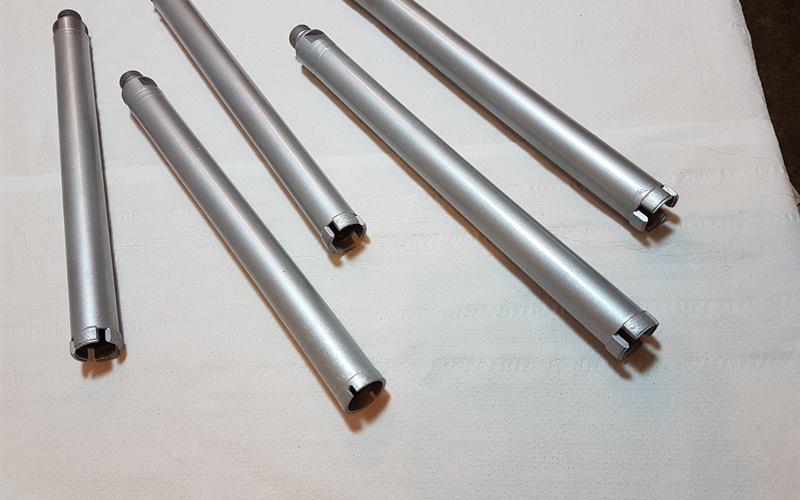
The key points in 30 seconds
- Rule: working length + extension ≥ wall thickness + about 20 mm.
- In stages: drill the tube length, withdraw the bit, break out the core, fit the extension, keep drilling.
- The same thread on the drill, extension and core bit – most often 1 1/4" UNC.
- Slab: the last core drops down – cordon off the area below.
- Thick walls in series – a longer core bit is cheaper and simpler than an extension.
Core bit working length – how deep can you really drill?
The working length is the part of the core bit that can enter the material – from the segment face to where the tube meets the mounting. It also sets how much core fits inside: a core longer than the tube has nowhere to go, so you cannot drill deeper without removing it.
- About 20 mm marginThe bit must break through on the far side and the mounting must not reach the wall face. That is why the working length (with extension) should be about 20 mm greater than the wall thickness.
- Typical lengthsWet core bits for reinforced concrete are usually 400, 450 or 500 mm long, large-diameter bits 450–600 mm, dry bits for masonry 150–300 mm. Other lengths are made to order.
- An extension increases the reachA 200, 300 or 500 mm extension screwed between the drill and the core bit lets you drill deeper, but it does not increase the “capacity” of the tube – you still remove the core every working length.
The working length and extension for a specific wall can also be worked out by the core bit configurator – enter the wall thickness and it shows whether an extension is needed.
How to drill a hole deeper than the core bit – step by step
- Drill to the working lengthWet, with a steady water flow. Stop before the mounting reaches the wall face – the tube must come out of the hole without yanking.
- Withdraw the bit and remove the coreThe core usually stays in the hole, still attached to the concrete at the bottom. Insert a wedge or flat chisel into the gap left by the segment, break the core out and remove it. Details in the section how to remove the core.
- Fit the extensionThe same thread as the drill and core bit. Clean the slurry off the threads and tighten fully – a loose joint runs out of true and works loose in the hole.
- Guide the bit in and start gentlyThe bit enters the existing hole and is guided by it. Drill the first centimetres with light pressure until the segments sit evenly on the bottom.
- Repeat until you break throughRemove the core every working length. On the last section reduce the pressure – the core and the edge on the far side break out easily.
Wall thickness – which core bit and extension?
Selection based on the rule “working length + extension ≥ thickness + 20 mm”, with core bits of 400–600 mm and extensions of 200, 300 or 500 mm.
| Wall thickness | Reach needed | Solution | Core removals on the way |
|---|---|---|---|
| up to 380 mm | up to 400 mm | 400 mm core bit | 0 |
| 400 mm | 420 mm | 450 mm core bit | 0 |
| 500 mm | 520 mm | 450 mm + 200 mm extension or a 600 mm core bit (large diameters) | 1 or 0 |
| 600 mm | 620 mm | 450 mm + 200 mm extension | 1 |
| 700 mm | 720 mm | 450 mm + 300 mm extension | 1 |
| 800 mm | 820 mm | 450 mm + 500 mm extension | 1 |
| 1000 mm | 1020 mm | 600 mm + 500 mm extension or a custom-length core bit | 1 |
| over 1000 mm | – | custom-length core bit – ask us | depends on length |
If you drill many holes through the same thickness, a longer core bit saves time: fewer stops to remove the core and one threaded joint less. An extension works well for occasional thicker walls.
Extension and core calculator
Enter the wall thickness, the core bit working length and the diameter. We will work out the extension, the number of core removals and the approximate core weight.
How do you remove a core from a hole in concrete?
- Core in the hole. After the bit is withdrawn the core usually stays in the hole, still attached to the concrete at the bottom. Insert a wedge or flat chisel into the gap left by the segment and lever – the core snaps at the base. Pull out a long or heavy core with a core grab or by levering it gradually from several sides.
- Core in the core bit. If it came out with the bit and is stuck in the tube, unscrew the bit, tap the tube with a rubber mallet or push the core out from the mounting end. Never hit the body with a steel hammer: a dented tube runs out of true and jams in the next holes.
- Rebar in the core. A cut bar holds the core more firmly. Lever carefully from several sides – do not yank with the drill, or you will break segments or tear out the rig.
- Slab. When drilling from above, the last core drops below the slab once you break through – cordon off the area underneath or support the core from below. When drilling from below, the core slides towards the operator and the drill – plan how you will catch it.
Weight matters. A Ø 140 mm core 500 mm long weighs about 18 kg, and a Ø 190 mm × 600 mm core about 41 kg. Remove heavy cores with two people or with a core grab – work out the weight in the calculator.
A long hole – straight and without jamming
- Rig anchored and levelled. At a depth of several tens of centimetres every degree of misalignment means a few millimetres of axis offset. For long holes the drill must be on a rig, not hand-held.
- Fewer joints, less runout. Every extension adds a threaded joint and a longer lever. A bent tube, a dirty thread or too long an assembly cause runout and jamming.
- Water along the whole depth. In a long hole the slurry must flow out. Keep a steady flow and now and then withdraw the bit a few centimetres to flush the slurry.
- Segment side clearance. The segments are wider than the tube – this clearance lets the tube run freely in the hole. A worn core bit whose segments are level with the tube jams fastest in a deep hole. More in the answer why does a core bit jam.
- Same speed. An extension does not change the diameter, so the gear stays the same – choose it from the rpm table.
Can you drill from both sides of a wall?
Yes – when there is no extension or access from one side is limited. The hole axis must then be transferred precisely to the other side (e.g. with a small-diameter pilot hole), and both drills set up parallel. Any misalignment leaves a step in the middle that makes it harder to pass the pipe through and seal it. For watertight and fire-stopped penetrations it is better to drill from one side with a core bit of the right length.
Thick walls and extensions – questions and answers
How do you drill a hole deeper than the core bit?
Drill to the working length, withdraw the bit, break out and remove the core, then fit an extension with the same thread and keep drilling. For thick walls it is better to choose a longer core bit from the start – see the wall thickness table.
Which extension should I choose for a core bit?
One with the same thread as the drill and the core bit, e.g. 1 1/4" UNC, and long enough for the bit's working length plus the extension to exceed the wall thickness by about 20 mm. We offer extensions of 200, 300 and 500 mm. Check your thread in the thread chart.
How do you remove a core from a hole in concrete?
Withdraw the bit, insert a wedge or flat chisel into the gap left by the segment and lever the core until it snaps at the base. Then lift it out by hand or with a core grab. Do not strike the core bit tube – a dented body runs out of true and jams.
What if the core gets stuck in the core bit?
Unscrew the core bit and remove the core by tapping the tube with a rubber mallet or pushing the core out from the mounting end. Never hit the body with a steel hammer. A core that keeps jamming is a sign that the tube is dented or the segments have lost their side clearance.
Can you drill from both sides of a wall?
Yes, when no extension is available, but the hole axis must be transferred precisely to the other side. Any offset leaves a step in the middle of the wall that makes fitting the pipe harder.
How much does a concrete core weigh?
At a concrete density of about 2.4 t/m³, a core 140 mm in diameter and 500 mm long weighs about 18 kg, and a 190 mm × 600 mm core about 41 kg. When drilling through a slab, the last core drops below – the area underneath must be cordoned off.
On this topic: core drilling in concrete
This guide is part of the hub Core drilling in concrete. Related articles and tools:
- How to match a core bit to a core drill – thread chart – the extension thread must match the machine and the bit.
- Hole diameters for building services – boxes, drainage, ventilation and a core bit calculator.
- Core drill speed and bit diameter – an rpm table and a gear calculator.
- Core bit configurator – working length and extension for the wall thickness.
- Core bit tubes – core bit bodies in different lengths.
- Dry or wet core bit – material, dust and a drilling mode calculator.