Stone processing & quarries
Diamond tools for granite and natural stone. A blade that does not glaze.
Large-diameter blades, diamond wire and bridge saw blades with a bond matched to your stone. Made in Lower Silesia, Poland – in the middle of one of Europe's major granite regions – and delivered across Europe.
- Bond for your stonegranite, syenite, basalt, marble
- Blades up to Ø 3500 mmand wire for blocks
- Large-blade retippinglogistics agreed with you
- Granite region know-howproduction in Lower Silesia
From the bench to the worktop
A tool for every stage of stone processing
Each stage has a different tool, a different machine and a different segment load. That is why a bond for cutting blocks is not the same as one for cutting slabs.
-
01
Block extraction
Diamond wire at the quarry face – splitting and squaring blocks.
Diamond wire for granite -
02
Block cutting
Large-diameter blades and wire saws – cutting blocks into slabs.
Large-diameter blades -
03
Slab cutting
Bridge saw – slabs, steps, sills and cut-to-size pieces.
Bridge saw blades -
04
Finishing and installation
Chamfering, holes in worktops for taps and sinks, trimming on site.
Core bits and M14 blades
Bond selection by stone
Which stone, which bond
The rule is simple: the harder the stone, the softer the bond; the more abrasive, the harder the bond. We refine the details on your deposit – granite from two quarries can cut completely differently.
| Stone | Hardness | Abrasiveness | Bond | Typical tools |
|---|---|---|---|---|
| Granite | high | low–medium | soft | bridge saw and block blades, wire |
| Syenite, basalt | very high | low | very soft | block blades, wire |
| Gneiss, quartzite | high | high | medium | blades, wire |
| Marble | medium | low | medium-hard | bridge saw blades, core bits |
| Limestone | low–medium | medium | hard | blades, wire |
| Sandstone | low–medium | very high | very hard | blades with core protection |
Indicative values – properties vary within the same type of stone. Try the interactive bond selector.
What stone plants come to us with
Four problems that stop the line
The blade glazes
Cause: the bond is too hard for the granite – diamonds go blunt, new ones are not exposed.
Fix: a softer bond for the stone hardness, refined in a trial on your deposit.
Frequent blade changes
Cause: a catalogue tool that does not match the stone or the machine.
Fix: a bond developed for your cut – more metres per blade.
The blade wanders, slabs vary in thickness
Cause: uneven segment wear, core tension or run-out.
Fix: run-out check, segments from one batch, a core matched to the machine.
Shipping large blades for retipping
Cause: a large-diameter blade leaves the plant for days.
Fix: planned retipping with a spare blade set and logistics agreed in advance.
Model scenario
Granite, bridge saw, 20,000 m of cutting a month
A scenario based on market benchmarks: a standard market blade versus a bond refined over three versions.
75 fewer changes and 56 fewer hours of downtime a year – about €52,000 saved, even though the custom-bond blade costs more.
A model scenario, not the result of a specific customer. See the full calculation or calculate your own case.
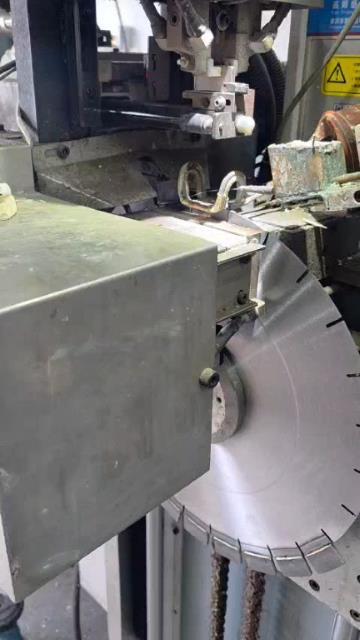
Stone blade retipping
New segments in your bond on the same core.
We retip large-diameter and bridge saw blades with segments in your own bond. For customers outside Poland we agree the scope, schedule and shipping before the blades are sent – so your line keeps running on a spare set.
- Diameters
- 1600–3500 mm
- Segments
- in your bond
- Report
- with every retip
A bond for your stone
Tell us what you cut – a technologist will get back to you
Stone, machines, what is not working today. We review your current tools – on site or remotely with your data – and prepare a paid trial batch.
- 01Call and production review
- 02Bond formulation and trial batch
- 03Metres compared and refined
Which diamond blade for granite?
Hard granite needs a soft bond that wears and exposes fresh grit. For slabs – a bridge saw blade; for blocks – a large-diameter blade or diamond wire. See granite blades.
Why does a blade glaze on granite?
The bond is too hard for the stone: the diamonds go blunt, while the bond does not wear and expose new grit. Cutting an abrasive material helps in the short term; a softer bond matched to your granite is the lasting fix.
Wire or blade for cutting blocks?
Diamond wire cuts blocks of any size and works well at the quarry face. A large-diameter blade gives faster, repeatable cuts when squaring blocks in the plant. They often work side by side. See diamond wire.
Do you retip large stone blades?
Yes – with new segments in your bond and a report after every retip. For customers outside Poland, the scope and shipping are agreed before the blades are sent.
Does granite from different quarries need a different bond?
Often, yes. Mineral composition, grain size and quartz content vary between quarries. That is why we refine the bond in a trial on your stone.
Who are you? See what you gain
All industries