Technologist's guide · Tool selection
Asphalt blade vs concrete blade– what is the difference and what happens if you swap them.
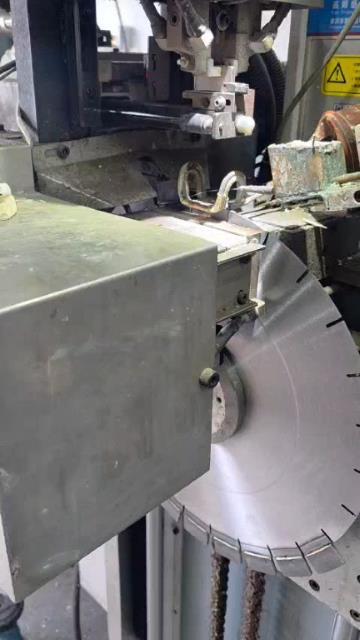
An asphalt blade and a concrete blade differ above all in the bond and core protection. Asphalt is soft but very abrasive, so an asphalt blade has a hard bond, coarser grit and protection segments that stop slurry from undercutting the steel beneath the segments. Cured concrete is hard and blunts the diamond, so a concrete blade has a bond matched to the aggregate – usually medium or soft – and grit that withstands rebar. Swapping them goes wrong both ways: a concrete blade in asphalt wears away before your eyes and can lose segments, and an asphalt blade on concrete glazes and hardly cuts.
The key points in 30 seconds
- Asphalt: soft but highly abrasive → hard bond, coarser grit, core protection segments.
- Cured concrete: hard, blunts the diamond → bond matched to the aggregate (medium or soft), grit that withstands rebar.
- Concrete blade in asphalt: fast wear, undercut core, risk of losing a segment.
- Asphalt blade on concrete: glazing, overheating, almost no cutting progress.
- Green concrete is cut like asphalt; asphalt on concrete – with a combination blade or in two passes.
Asphalt blade vs concrete blade – differences in a table
| Parameter | Asphalt blade | Concrete blade |
|---|---|---|
| Bond | hard – abrasion-resistant | matched to the aggregate – usually medium or soft |
| Diamond concentration | lower (approx. C15–C20) | medium to increased (approx. C25–C40) |
| Grit size | coarser, approx. 30/40 mesh | medium, approx. 40/50 mesh |
| Core protection | protection segments (angled, “drop”) against undercutting | usually none – concrete undercuts the core less |
| Segment | often taller, wider gaps to clear sticky debris | designed for hard aggregate and rebar |
| Rebar | not designed for cutting bars | for reinforced concrete – impact-resistant grit |
| Cooling | wet – cools and prevents the segments from clogging | wet for large blades and reinforced concrete |
Concentration and grit size values are indicative – actual formulations differ between manufacturers and series.
Why do asphalt and concrete need different blades?
Every diamond segment works in balance: the bond should wear at exactly the rate the diamond goes blunt. Asphalt and concrete push this balance in opposite directions.
- Asphalt is aggregate and sand bound with bitumen. It is soft – the blade enters it easily – but the sharp sand and aggregate grains combined with water form a slurry that acts like grinding paste. It wears the bond and the steel of the core. The diamond goes blunt slowly, but everything around it wears quickly – hence the hard bond.
- Cured concrete is hard and dense. The aggregate – especially granite or basalt – blunts the diamond quickly, and there is less abrasion. The bond must be soft enough to wear and expose new grit. Details: concrete blade for granite aggregate.
The same rule applies across all selection: hard material – soft bond, abrasive material – hard bond. Asphalt and cured concrete with hard aggregate sit at opposite ends of this scale.
Core undercutting – the biggest risk with asphalt
In asphalt and green concrete it is not the segment that wears fastest, but the steel of the core just beneath it. Abrasive slurry circulates in the cut and washes the core away at the sides until only a thin “waist” is left under the segment. Then one impact or overheating is enough for the segment to come off – a lost tool and a real danger to the operator.
That is why asphalt blades have protection segments: angled or projecting segments between the cutting segments that shield the steel from the slurry. A concrete blade usually has no such protection, because undercutting is much weaker in cured concrete.
An undercut core rules the blade out of further use, and with deep undercutting also out of retipping. Check the steel at the segment seats at every work break.
What happens if you swap blades?
Choose a situation from the site and we will show the consequences and the right choice:
- What happens
- The right choice
- What to watch for
Green concrete is cut like asphalt
Concrete just after pouring – when cutting expansion joints in floors and pavements – is not hard yet, but it contains a lot of sand and cement paste that is not fully bound. It acts on the segment like asphalt: it wears the bond heavily and undercuts the core. That is why green concrete is cut with blades with a hard bond and core protection – often the same series that manufacturers label “asphalt / green concrete”.
The boundary is not sharp: concrete hardens day by day. An asphalt blade that cuts joints well the day after pouring will start to glaze on the same concrete after a few weeks. In the selection table we treat green concrete (roughly up to about 28 days) as an abrasive material – see how to cut green concrete.
Asphalt on a concrete slab – which blade?
On bridges, car parks and in road repairs, asphalt laid on a concrete slab is often cut. One cut then contains two opposite materials. There are two sensible approaches:
Combination blade
- One blade for both layersA compromise bond and core protection – no blade change during the work.
- WhenA thin concrete or asphalt layer, little rebar, short runs.
Two passes
- Asphalt with an asphalt blade, concrete with a concrete bladeEach blade works in its own material – the highest output and life.
- WhenA thick slab, rebar, long runs and series work.
When cutting bridge decks and infrastructure pavements, it is worth making the selection for the specific cross-section – concrete cutting tools and solutions for roads and bridges.
How to recognise an asphalt blade
- Manufacturer's marking. A pictogram or material description on the core – “asphalt”, “asphalt / green concrete”, “concrete”, “reinforced concrete”. This is the only reliable information.
- Protection segments. Angled or projecting segments between the cutting segments – typical of asphalt blades.
- Wider gaps and taller segments. They help clear sticky debris and give a wear reserve.
- Core colour is not a marking. Manufacturers paint cores according to their own series – you cannot tell the material from the colour.
Have a blade without a legible description? Give us the diameter, bore and machine – the blade finder will show asphalt and concrete series, and an advisor will help you choose the right one.
Asphalt bladesAsphalt blade vs concrete blade – questions and answers
Can a concrete blade cut asphalt?
Briefly and in an emergency – yes, but the blade will wear very quickly, because its bond is not abrasion-resistant. The abrasive slurry also undercuts the core beneath the segments, which risks losing a segment. Use an asphalt blade for asphalt.
Can an asphalt blade cut concrete?
Green concrete – yes, that is a typical use. Cured concrete – practically not: the hard bond does not wear, the segment glazes, and the blade hardly cuts and overheats.
Why does an asphalt blade have a hard bond?
Because asphalt is soft but very abrasive. A soft bond would wear away before the diamond had time to work. A hard bond holds the grit longer in an abrasive material.
What are protection segments on an asphalt blade?
Additional, often angled or projecting segments that shield the steel core from abrasive slurry. They prevent the core being undercut beneath the cutting segments and the segments coming off.
Which blade for asphalt on concrete?
A combination blade for asphalt and concrete with core protection for thin layers and short runs, or two passes – asphalt with an asphalt blade, concrete with a concrete blade – for a thick slab, rebar and series work.
Is asphalt cut wet?
Usually yes. Water cools the segments, flushes out the slurry and limits bitumen sticking to the segments as well as dust.
On this topic: diamond tool selection
This guide is part of the hub Diamond tool selection. Related answers and tools:
- Concrete blade for granite aggregate – the opposite mistake: a bond too hard for hard aggregate.
- Bond, concentration, grit size – how to read a segment specification, with a decoder.
- Hard or soft bond for concrete? – the rule in two sentences.
- Problems and wear diagnosis – undercutting, glazing, lost segments.
- Interactive bond selector – asphalt, concrete, granite, porcelain, abrasive materials.
- Straight, turbo or roof-top segment – segment shape and starting the cut, cooling and debris.
Also: cut-off saw blade. Coming soon: straight, turbo or roof-top segment.