Concrete cutting & demolition
Concrete cutting tools for reinforced concrete. Count metres, not blades.
Wall saw and floor saw blades, core bits and diamond wire for concrete cutting and drilling contractors. We match the bond to your aggregate and the grit to your rebar. Try it on your own job with a test blade.
- Bond for your aggregatehard, medium, abrasive
- Grit for rebarimpact-resistant
- Test bladeside-by-side on your job
- Retippingblades and core bits with a report
Recommendation
- Concentration
- Grit
- Cooling
Indicative selection – a technical advisor confirms the specification.
Typical work
From a door opening to demolishing an abutment
Every job has its machine, its cutting depth and its load on the segment. We match the tool to the job, not the other way round.
- 01
Openings in walls
Doors, windows, process openings – a wall saw on a track, a clean edge.
Wall saw blades - 02
Controlled demolition
Massive elements, foundations, abutments – wire sawing without vibration or dust.
Diamond wire - 03
Penetrations and coring
Service penetrations, anchors, test cores – a stand-mounted core drill.
Core bits for reinforced concrete - 04
Joints and slabs
Cutting slabs, floors and concrete pavements with a floor saw.
Floor saw blades
What concrete you cut
The same "concrete", five different blades
Blade life depends on the aggregate and the rebar, not the concrete grade alone. That is why we ask where the aggregate comes from and how dense the reinforcement is before we recommend a blade.
| Material | Hardness | Abrasiveness | Bond | Watch out for |
|---|---|---|---|---|
| Reinforced concrete, granite / basalt aggregate | very high | low | soft | glazing, impact on rebar |
| Reinforced concrete, gravel aggregate | high | medium | medium | rebar density |
| Heavily reinforced concrete | high | medium | medium + impact grit | segment breakage |
| Prestressed concrete, precast | high | medium | medium | tendons – check with the designer |
| Green concrete (up to 28 days) | low | very high | hard | core undercutting |
| Screed, sandy concrete | low | very high | very hard | rapid segment wear |
Indicative values. Try the interactive bond selector or the size and cutting depth table.
What operators come to us with
Four problems that cost more than the blade
The blade stops cutting
Cause: glazing – the bond is too hard for the aggregate.
Fix: a softer bond for hard aggregate; in the short term, dress the blade in an abrasive material.
Slow cutting through rebar
Cause: grit with low impact resistance, concentration too low.
Fix: impact grit, higher concentration, less pressure on the bar.
Lost segments
Cause: overheating, dry cutting, a weak joint.
Fix: water cooling, a joint test on every segment, an inspection report.
Saw vibration and run-out
Cause: a bent or overheated core, wrong speed.
Fix: run-out check, a core matched to machine power, retipping with measurement.
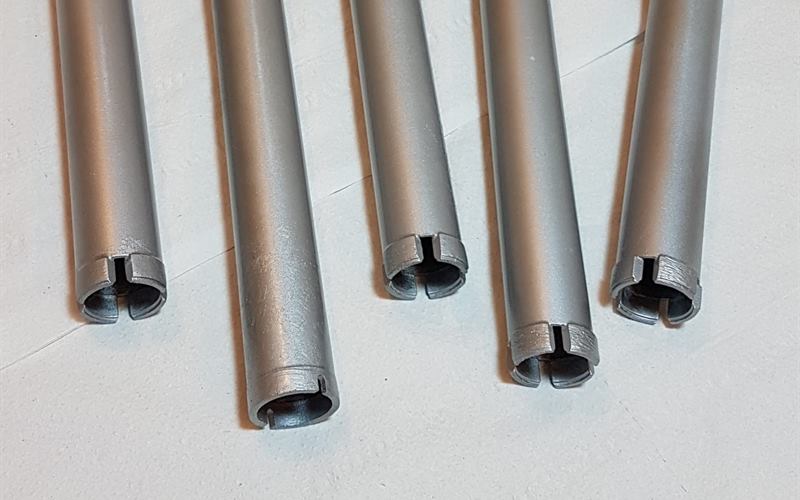
Blade and core bit retipping
Worn segments? The core goes back to work.
We retip wall saw and floor saw blades and core bits – other brands too. Prices on request, shipping agreed with you, an inspection report with every tool.
Request retippingTest blade
Try it on your own concrete before you buy a series
An advisor matches a blade to your aggregate and machine, then you compare it on site with your current blade: m²/h and metres per segment. Delivery terms are agreed with you.
- 01Describe the concrete and machine
- 02We select the bond and segment
- 03Side-by-side trial on your job
Which blade for cutting reinforced concrete?
A blade with impact-resistant grit and higher diamond concentration, a bond matched to the aggregate hardness, used wet. Use the tool selector or the blade finder.
Why won't my blade cut concrete?
Usually because it has glazed – the bond is too hard for the aggregate, the diamonds go blunt and no new ones are exposed. Cutting an abrasive material helps in the short term; a blade with a softer bond is the lasting fix.
Wall saw or wire saw for demolition?
A wall saw cuts walls and slabs with a precise edge, to a depth that depends on the blade diameter. Diamond wire cuts massive elements of any cross-section – foundations, abutments, columns. See diamond wire.
How deep does a wall saw cut?
Roughly half the difference between the blade and flange diameters – an 800 mm blade cuts about 330 mm deep. Check your setup in the cutting depth calculator.
Can reinforced concrete be cut dry?
Only briefly, with blades designed for dry cutting and with dust extraction. For reinforced concrete we recommend wet cutting – it cools the segments when they hit steel and limits silica dust.
Who are you? See what you gain
All industries