OnlyTools Knowledge
Diamond tool knowledge.Answers from technologists, not copywriters.
Short, specific answers to the questions we hear from operators, production managers and buyers: how to match the bond to the material, why a blade stops cutting, what thread a core drill has and what the cost per metre cut depends on.
- 6categories
- 31answers
- 26glossary terms
- 7online tools
Most asked:
- Type a few words – we search 31 answers and 26 definitions.
Latest articles
From the technologists' blog
Tool selection · New
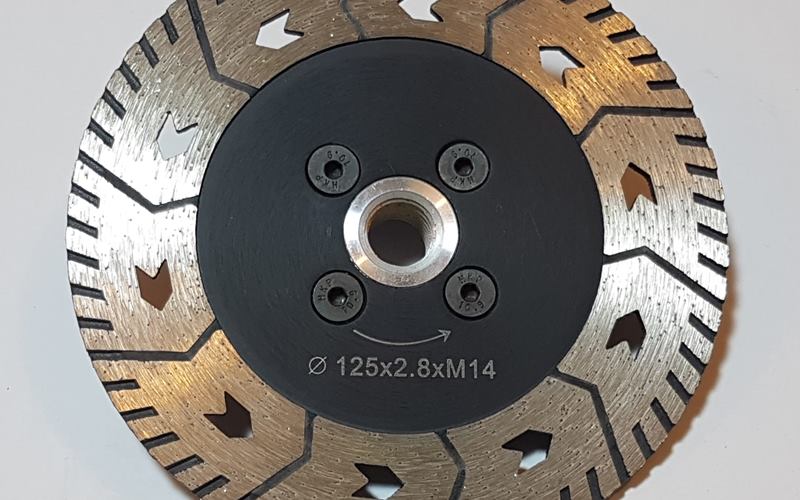
Straight, turbo or roof-top segment – which to choose
Segment shape and starting the cut, cooling and debris: straight, roof-top, turbo, sandwich and continuous rim – with a shape selector.
Published: · 5 min read
- Core drilling
Dry or wet core drilling – material, dust and core bit life
A material table from reinforced concrete to porcelain, silica dust, slurry and a drilling mode calculator.
- Core drilling
Core drilling through thick walls – extensions and cores
A hole deeper than the core bit: 200–500 mm extensions, core removal and an extension calculator.
- Core drilling
Core drill speed and bit diameter – rpm table and calculator
Peripheral speed of 3–5 m/s, an rpm table for 25–500 mm and a core drill gear calculator.
- Core drilling
Hole diameters for building services – boxes, drainage, ventilation
How much clearance to leave for sealing and insulation – tables and a core bit diameter calculator.
- Core drilling
How to match a core bit to a core drill – thread chart
1 1/4" UNC, 1/2" BSP, M16, M14 and SDS-plus – how to check your core drill thread and when an adapter is enough.
- Tool selection
How to choose a cut-off saw blade
300–400 mm diameter, 20 or 25.4 mm bore, 100 m/s speed, a blade for the material – with an online blade selector.
- Tool selection
Asphalt blade vs concrete blade – what is the difference
A hard bond and core protection versus a bond matched to the aggregate – what happens if you swap blades.
- Tool selection
Concrete blade for granite aggregate – why a “standard” one is not enough
Hard aggregate blunts the diamond but does not wear the bond – the nail test and choosing a soft bond.
- Tool selection
Bond, concentration, grit size – how to read a segment specification
What C25 and 40/50 mesh mean, hard or soft bond – with a specification decoder.
- Concrete cutting
Cutting reinforced concrete: how to avoid losing segments on rebar
Feed pressure, speed, cooling and grit selection – with a peripheral speed calculator.
- Costs and retipping
Diamond tool retipping – methods, costs and benefits
Brazing or laser, what it costs and when it pays off – plus retipping with a bond correction.
Categories
Choose a topic – every category starts with an answer.
- Diamond tool selectionA diamond tool is chosen in three steps: the machine sets the diameter, bore and power; the material sets the bond hardness, concentration and diamond grit size; the working conditions set the cooling and segment shape.
- Concrete and reinforced concrete cuttingConcrete and reinforced concrete are cut with three methods: a wall saw (walls and slabs, a precise edge), a floor saw (slabs, floors, expansion joints) and diamond wire (massive elements of any cross-section).
- Core drilling in concreteA hole in concrete is drilled with a diamond core bit chosen for the diameter, the core drill's thread and the material.
- Granite and stone processingHard granite, syenite and basalt need a soft bond that exposes new grit; abrasive sandstones and limestones need a hard one.
- Problems and wear diagnosisThe most common problems with diamond tools have four causes: a bond not matched to the material (glazing or too fast wear), overheating without cooling (lost segments), wrong operating parameters (feed pressure, speed) and a damaged core (run-out, vibration).
- Cutting costs and retippingThe cost per metre cut is the sum of labour, machine and tool costs divided by output.
- GlossaryBond, mesh, glazing, UNC – definitions in two sentences.
Most common questions
Six questions we hear most often.
One from each category. Full answers and more questions are in the categories.
Where do you start when choosing a diamond blade?
With the machine: diameter, arbor bore and power follow from the saw. Only then are the bond and segment matched to the material – aggregate hardness, amount of rebar and abrasiveness. More: Diamond tool selection
How deep does a wall saw cut?
Roughly half the difference between the blade and flange diameters. A Ø 800 mm blade cuts about 330 mm deep, Ø 1600 mm about 730 mm; thicker elements are cut from both sides or with wire. More: Concrete and reinforced concrete cutting
What thread does a diamond core bit have?
Most wet core drilling rigs have a 1 1/4" UNC spindle. Small core bits, usually up to Ø 62 mm, have 1/2" BSP. Dry core bits for masonry – M16, for porcelain on an angle grinder – M14. How to check it: core bit thread chart. More: Core drilling in concrete
Which diamond blade for granite?
A blade with a soft bond that wears and exposes new grit. For slabs – a bridge saw blade, for blocks – a large-diameter blade or diamond wire. More: Granite and stone processing
Why does a diamond blade stop cutting?
Usually it is glazing: the bond is too hard for the material, the diamonds go blunt and do not expose new ones. Cutting an abrasive material helps in the short term; a blade with a softer bond is the lasting fix. More: Problems and wear diagnosis
How do you calculate the cost per metre cut?
Add up the hourly cost of the crew and the machine, divide by output in m²/h, then add the tool price divided by the number of metres it will cut. The cost per metre calculator does this automatically. More: Cutting costs and retipping
Online tools
Calculate and choose for yourself before you ask.
How this content is made
We write the way we answer on the phone.
- The answer firstThe first sentence of every section answers the question. Context and exceptions come after.
- Authors from productionThe content is prepared by the technology department, which formulates bonds and presses segments in Zagórze Śląskie, Poland.
- Figures with caveatsValues are indicative and depend on material, machine and cooling. We say so openly.
- Review dateEvery page has an update date. Last review: .
Didn't find an answer?