Technologist's guide · Tool selection
Concrete blade for granite aggregate– why a “standard” one is not enough.
Concrete with granite or basalt aggregate is cut with a blade with a soft bond, not a “standard” concrete blade. Granite (about 6–7 on the Mohs scale) blunts the diamond quickly but hardly wears the metal bond. A universal blade has a bond designed for concrete with gravel and sand, which wears by itself – on hard aggregate it stops exposing new grit and glazes. The symptom: the blade cuts more and more slowly and the segments become smooth and shiny. The solution: a blade with a soft bond matched to the aggregate, not to “concrete” in general.
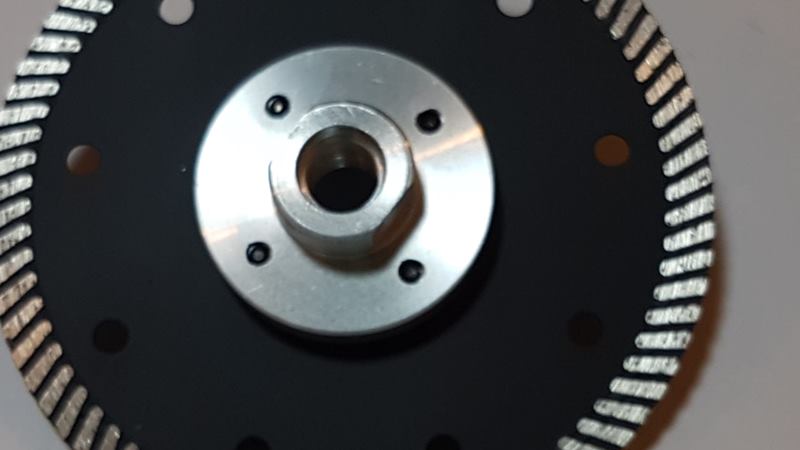
The key points in 30 seconds
- The problem: a “concrete blade” is usually a blade for concrete with gravel and sand. On granite and basalt aggregate its bond is too hard.
- The rule: hard aggregate → soft bond; abrasive (sand, green concrete) → hard.
- Symptom of the wrong blade: ever slower cutting, smooth and shiny segments, speed drop, overheating.
- Field test: a steel nail does not scratch granite or basalt – it scratches limestone and dolomite.
- Cost per metre is what counts: a more expensive blade matched to the aggregate usually cuts more cheaply than a “universal” one.
Why does a “standard” concrete blade glaze on granite aggregate?
A diamond segment only works when the bond wears at the same rate as the diamonds go blunt. Then the blunt grit falls out and a new, sharp grain comes up from below. In concrete this balance is set by two things at once: the hardness of the aggregate, which blunts the diamond, and the abrasiveness of the mortar and sand, which wears the bond.
A typical “concrete” blade is designed for the most common case – concrete with gravel aggregate and plenty of sand. Such concrete wears the bond, so the blade has a medium or fairly hard bond. On granite aggregate something different happens: hard quartz and feldspar grains blunt the diamond quickly, and there is little abrasion. The bond stops wearing, the blunt diamonds stay in place, the segment surface goes smooth – that is glazing. The blade starts “polishing” the cut instead of cutting.
For us this is everyday reality, not theory: we manufacture in Lower Silesia, a region of granite (around Strzegom and Strzelin) and basalt deposits. Concrete with crushed granite or basalt aggregate is found here in industrial, bridge and road structures far more often than in many other regions.
Which aggregate – which bond: selection table
The key question before choosing a concrete blade is not “what concrete class?” but “what aggregate and how much sand?”. As a guide:
| Aggregate | Hardness (Mohs, indicative) | Effect on the segment | Blade bond |
|---|---|---|---|
| Crushed granite | approx. 6–7 | Blunts the diamond, wears the bond little | soft |
| Basalt, gabbro, melaphyre | approx. 6 | Blunts the diamond; very dense and strong | soft, sometimes very soft |
| Natural gravel (quartz pebbles) | approx. 7 (quartz) | Blunts the diamond, while sand wears the bond – a balance | medium |
| Limestone, dolomite | approx. 3–4 | Blunts the diamond little, mortar wears the bond | medium to hard |
| Green concrete, a lot of sand | – | Heavily wears the bond and the core | hard + core protection |
The Mohs scale describes a mineral's resistance to scratching and is only a first filter. Blade performance also depends on concrete strength, the amount and type of sand, rebar, machine power and cooling. We expand on the bond selection rule in the guide bond, concentration, grit size.
How do you identify the aggregate in concrete on site?
Most reliably from the documentation: the drawings, the mix design or the concrete plant's declaration state the aggregate type. If you do not have it, three observations on a fresh cut or a broken piece are enough:
- Appearance. Granite – sharp-edged grains with visible crystals (light, pinkish, grey specks). Basalt – dark grey to black, fine-grained, uniform. Gravel – rounded pebbles, often translucent or milky (quartz). Limestone and dolomite – light, matt, uniform.
- Nail test. A steel nail or knife blade (about 5.5 on the Mohs scale) scratches limestone and dolomite, but does not scratch granite, basalt or quartz.
- The first metres of cutting. If a blade that cut well on other sites slows down here after a few metres and the segments shine – you have hard aggregate.
Choose the aggregate you see and we will show what it does to the segment and which bond to choose:
- Hardness and abrasiveness
- Which bond and segment
- What to watch for
How can you tell a blade does not suit the aggregate?
Bond too hard (typical on granite)
- Ever slower cuttingAfter a few metres the blade slows down, although the segments wear very little.
- Smooth, shiny segmentsNo protruding diamond grains are visible.
- Speed drop, overheatingThe machine “chokes”, the operator increases the feed pressure – which only makes things worse.
Bond too soft (the opposite mistake)
- Fast, easy cuttingAt first the blade “flies”, but the segments disappear before your eyes.
- Short lifeA “granite” blade on sandy or green concrete will wear many times faster.
- Undercut coreAbrasive slurry washes away the steel beneath the segments.
In the short term a few cuts in an abrasive material – a dressing stone, brick, sandstone – “open up” a glazed blade. But that treats the symptom: after a few metres in granite aggregate the segment will glaze again. Lasting help comes only from a blade with a softer bond. More symptoms: problems and wear diagnosis.
Which blade for concrete with granite aggregate?
A segment for concrete with hard aggregate differs from a “universal” one in three places in the formulation:
Bond
Soft
Wears despite the low abrasiveness of the material and constantly exposes new grit. This is the most important difference.
- Effect
- The blade cuts evenly to the end of the segment's life, without glazing
Diamond
Quality and concentration
High-strength grit in a medium concentration (roughly C25–C30) – fewer grains work harder and bite into quartz more easily.
- Effect
- Faster cutting at the same machine power
Grit
Medium, approx. 40/50 mesh
A compromise between cutting speed and segment stability on hard material.
- Effect
- Stable cutting without segment chipping
When there is also rebar
Impact resistance
Reinforced concrete with granite aggregate is the hardest combination: the soft bond must also hold the grit under impacts on the bars.
Ready-made series are in the blade finder, and for unusual aggregate or high consumption it is worth ordering a formulation for your production. The selection rules for the whole material in one place: the interactive bond selector and concrete cutting tools.
Why does the “cheaper” blade end up costing more?
A glazed blade does not just cut more slowly. Every metre costs more operator and machine hours, and the blade is taken out of service before its segments are used up. So compare the tool cost per metre cut, not the blade price:
| Example | Blade price | Metres cut until replacement | Blade cost per metre |
|---|---|---|---|
| "Universal" blade (glazes) | 100% | 100% | 100% |
| Blade matched to the aggregate | approx. 125% | e.g. 200% | approx. 63% |
Example values showing the method – not a measurement. For a comparison, enter your own figures from invoices and work reports; on top of this comes operator time, which rises most with a glazed blade. Work it out with your own data in the cost per metre calculator.
What to give when ordering a blade for concrete with hard aggregate
- Aggregate typeGranite, basalt, gravel, limestone – ideally from the mix design or the quarry name.
- Age and strength of the concreteGreen or cured; the class, if you know it – high classes with basalt need an even softer bond.
- RebarNone, sparse, dense – it determines the segment's impact resistance.
- MachineWall saw, floor saw or hand-held cut-off saw; power and blade diameter.
- What happens with your current bladeDoes it glaze, wear fast, lose segments? That is the best clue for the technologist.
Concrete blade for granite aggregate – questions and answers
Why does a concrete blade stop cutting on granite aggregate?
Because its bond is too hard. Granite blunts the diamond quickly but hardly wears the bond – the blunt grit stays in place and the segment glazes. You need a blade with a soft bond.
What bond for concrete with basalt aggregate?
Soft, and for high-strength concrete even very soft. Basalt is hard and very dense, so it acts on the segment much like granite.
How do I check what aggregate is in the concrete?
Most reliably from the mix design or concrete documentation. On site, the look of the grains and the nail test help: a steel nail scratches limestone and dolomite, but not granite, basalt or quartz.
Can a glazed blade be dressed?
Yes, short term – a few cuts in an abrasive material (dressing stone, brick, sandstone) expose new grit. In concrete with hard aggregate the segment soon glazes again, so the lasting solution is a softer bond.
Is a granite blade suitable for ordinary concrete?
Usually not. On concrete with a lot of sand or on green concrete the soft bond will wear very quickly. The blade is matched to the aggregate and the abrasiveness of the concrete, not to the material's name alone. See also asphalt blade vs concrete blade.
Is the concrete strength class enough to choose a blade?
No. The class tells you about strength, but the segment's performance depends mainly on the type of aggregate and the amount of sand. Two concretes of the same class with granite and gravel aggregate need different blades.
On this topic: diamond tool selection
This guide is part of the hub Diamond tool selection. Related answers and tools:
- Hard or soft bond for concrete? – the rule in two sentences.
- Bond, concentration, grit size – how to read a segment specification – with a specification decoder.
- Cutting reinforced concrete: how to avoid losing segments on rebar – when the concrete is also reinforced.
- Diamond tools for granite – blades and wire for stone processing.
- Problems and wear diagnosis – glazing and other symptoms.
- Straight, turbo or roof-top segment – segment shape and starting the cut, cooling and debris.
New on this topic: asphalt blade vs concrete blade. Also: cut-off saw blade. Coming soon: straight, turbo or roof-top segment.