Technologist's guide · Tool selection
Bond, concentration, grit size – how to read a segment specificationThree parameters that decide whether a blade cuts fast and lasts.
A diamond segment specification is read through three parameters. The bond is the metal matrix that holds the diamond: the harder the material, the softer the bond, and the more abrasive it is, the harder the bond. Concentration says how much diamond there is: C100 is 4.4 carats per cm³ (25% by volume), and segments for concrete and stone usually have about C15–C40. Grit size is the grain size in mesh: 30/40 cuts fast and rough, 60/80 slower and clean. A blade cuts fast and lasts only when these three parameters are chosen together – for the material and the machine's power.
The key points in 30 seconds
- Bond: hard material (granite, quartz aggregate) – soft bond; abrasive (asphalt, green concrete) – hard. The wrong bond means glazing or wear “before your eyes”.
- Concentration: C100 = 4.4 ct/cm³ = 25% by volume. Higher – longer life, but slower and needing more power; lower – faster, shorter life.
- Grit size: 30/40 mesh (D602) – fast and rough; 60/80 mesh (D251) – slow and clean. The higher the mesh number, the finer the grit.
- Together: no parameter works alone – what counts is the combination of bond + concentration + grit for the material and the machine's power.
- Check your datasheet in the specification decoder below.
What is a diamond segment made of?
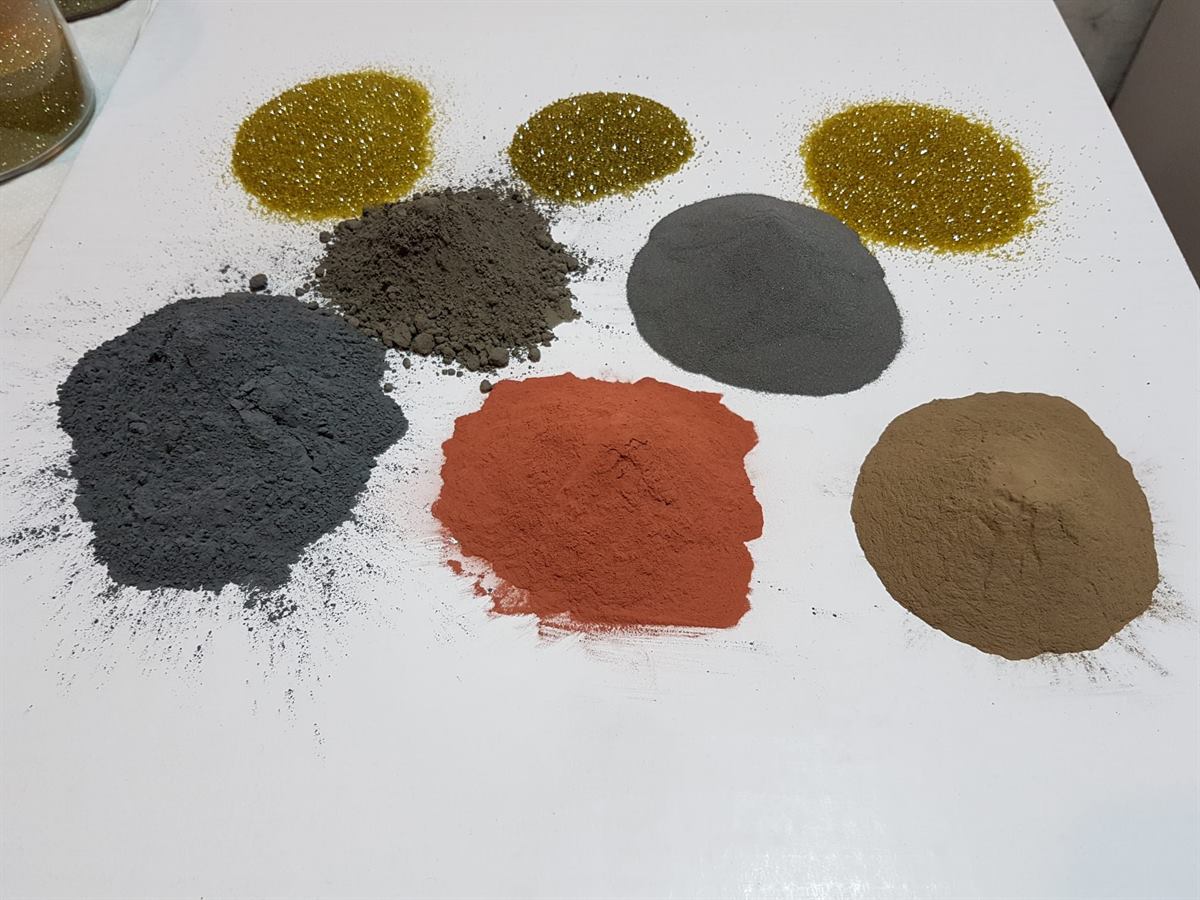
A diamond segment is a sintered part: a mix of metal powders and diamond grains, pressed and sintered at high temperature under pressure. The diamond cuts, the metal holds the diamond in place. It works like a self-sharpening file: when a grain on the surface goes blunt or falls out, the bond around it wears away and exposes the next sharp grain.
The three parameters on a segment datasheet describe exactly this balance:
| Parameter | What it describes | How it appears on the datasheet | What it affects |
|---|---|---|---|
| Bond | The composition and hardness of the metal matrix | Descriptively (soft, medium, hard) or as a manufacturer code | Whether the segment “self-sharpens” or glazes or wears too fast |
| Concentration | The amount of diamond in the segment volume | C25, C30… (C100 = 4.4 ct/cm³) or ct/cm³ | Life, required power, cutting speed |
| Grit size | The size of the diamond grains | Mesh (e.g. 40/50) or FEPA (e.g. D427) | Cutting speed, edge quality |
Bond – hard or soft?
The bond is the segment's metal matrix – usually a mix based on cobalt, iron, copper and bronze, often with carbides (e.g. tungsten carbide) that increase wear resistance. The composition determines how firmly the bond holds the diamond and how quickly it wears itself.
There is one selection rule, and it works “the other way round” from what intuition suggests:
- Hard, low-abrasion material → soft bond. Granite, quartz aggregate, basalt and porcelain blunt the diamond quickly but hardly wear the metal. The bond must wear by itself to expose new grit.
- Soft, abrasive material → hard bond. Asphalt, green concrete, brick and sandstone act like sandpaper. A soft bond would wear away before the diamond had time to work.
- Reinforced concrete → a medium bond that holds the grit under impact on the bars, matched to the aggregate hardness. More: grit and bond for dense rebar.
Bond too hard
- GlazingThe segment becomes smooth and shiny, the blade stops cutting, heats up and “wanders”.
- Seemingly long lifeThe segment hardly wears – because it hardly cuts.
Bond too soft
- Wear “before your eyes”The blade cuts very fast, but the segments are gone after a few metres.
- Grit falling outThe diamond falls out before it is blunt – you pay for unused diamond.
There is no single standard for marking bond hardness. Manufacturers use their own codes and descriptions, so “medium” from one does not have to mean the same from another. Ask your supplier not for the letter, but for the material the bond was designed for.
Diamond concentration – what does C25 or C40 mean?
Concentration is the amount of diamond in the segment volume. The scale is a convention: concentration 100 = 4.4 carats per cm³, which equals 25% by volume (1 carat = 0.2 g, diamond density about 3.52 g/cm³). The other values are proportional:
| Concentration | Carats per cm³ | % by volume | Diamond in a 40 × 3.2 × 10 mm segment* |
|---|---|---|---|
| C15 | 0.66 ct/cm³ | 3,75% | approx. 0.84 ct |
| C20 | 0.88 ct/cm³ | 5% | approx. 1.13 ct |
| C25 | 1.10 ct/cm³ | 6,25% | approx. 1.41 ct |
| C30 | 1.32 ct/cm³ | 7,5% | approx. 1.69 ct |
| C40 | 1.76 ct/cm³ | 10% | approx. 2.25 ct |
| C100 | 4.40 ct/cm³ | 25% | – (typical for grinding wheels, not saw segments) |
* For the whole segment volume of 1.28 cm³. Segments with a diamond-free layer at the base (for laser welding) contain correspondingly less.
More diamond does not automatically mean a better blade. A higher concentration means more cutting points: each grain carries less load, the segment lasts longer and copes better with rebar – but it cuts more slowly and needs more power and feed pressure. A lower concentration means fewer grains working harder: a faster start in soft and abrasive materials and better performance on weaker machines, at the cost of life.
Diamond grit size – what does 40/50 mesh mean?
Grit size describes the size of the grains. In mesh notation (e.g. 40/50) the numbers are sieves: the grit passes through sieve 40 and stays on sieve 50. The higher the numbers, the finer the grit. In Europe FEPA designations with the letter D are also used, where the number roughly corresponds to the largest grain in micrometres.
| Mesh (US) | FEPA | Grain size | Typical application |
|---|---|---|---|
| 30/40 | D602 | approx. 425–600 µm | Asphalt, green concrete, abrasive materials – fast, aggressive cutting |
| 40/50 | D427 | approx. 300–425 µm | Concrete and reinforced concrete – a universal compromise of speed and edge |
| 50/60 | D301 | approx. 250–300 µm | Granite and hard stone – an even cut, less chipping |
| 60/80 | D251 | approx. 180–250 µm | Porcelain, ceramics, polished stone – a clean edge |
Coarser grit penetrates deeper and removes more material per revolution, but leaves a rough edge and needs power. Fine grit cuts shallower and cleaner – in hard, brittle materials (porcelain) it protects the edge from chipping, but in soft and abrasive materials it cuts too slowly.
How do bond, concentration and grit size work together?
Segment parameters are like connected vessels – changing one shifts the optimum of the others. The most common relationships we see when designing formulations:
- Weaker machine → lower concentration or softer bond. Low power cannot “push” many grains at once – a high-concentration segment will start to glaze.
- Coarser grit → usually lower concentration. For the same mass of diamond there are fewer coarse grains, and each needs support in the bond.
- Rebar → higher concentration and impact-resistant grit. The impact is spread over more grains, and the bond must not release the diamond at every bar.
- Dry cutting → be careful with a hard bond. Without water the segment overheats and glazes more easily.
| Material | Bond | Concentration | Grit size |
|---|---|---|---|
| Concrete and reinforced concrete | medium | increased (approx. C30–C40) | 40/50 mesh |
| Concrete with granite aggregate | soft | medium (approx. C25–C30) | 40/50 mesh |
| Granite and hard stone | soft | medium (approx. C25–C30) | 40/50–50/60 mesh |
| Porcelain and ceramics | very soft | medium | 60/80 mesh |
| Asphalt, green concrete, sandstone | hard | low (approx. C15–C20) | 30/40 mesh |
Indicative values – in line with the selection rules used in the industry and in our interactive bond selector. The technologist sets the actual formulation once the material, machine and working conditions are known.
Decoder: does your specification suit the material?
Enter the parameters from the segment datasheet or from the quotation on your desk. The decoder compares them with the typical selection for the material and converts the concentration to carats.
What does a segment datasheet not tell you?
Two blades with “the same” specification can cut completely differently. Bond, concentration and grit size are only part of the formulation. The result also depends on what is usually not on the datasheet:
- Diamond quality. Synthetic grit comes in different grades – from cheaper, friable grit to grit with high impact strength, a regular shape and temperature resistance.
- Size spread. Whether a "40/50" bag contains even grit or a mix with a large share of fines.
- Grain distribution. Random or arranged grit; a uniform segment or a layered (sandwich) one with different layers in the middle and on the sides.
- Sintering process. Temperature, pressure and time decide how firmly the bond holds the diamond and whether the grit loses strength at too high a temperature.
- Joint to the core. Brazing or laser welding – important for dry work and for retipping.
That is why, when choosing a supplier, batch repeatability matters more than the datasheet itself: whether the next deliveries have the same formulation and dimensions. With segments from our production every batch passes a dimensional check, and the formulation can be corrected after a wear diagnosis.
5 questions worth asking your segment supplier
- What material was the bond designed for?Specifically: aggregate, rebar, asphalt, granite – not “for concrete”.
- What are the concentration and grit size?In C or ct/cm³ and in mesh or FEPA. A supplier who does not know does not control the formulation.
- What machine and power are assumed?The same segment works differently on a 10 kW saw and a 20 kW one.
- Wet or dry?The bond and the way the segment is joined to the core depend on it.
- Are the batches repeatable?Ask about dimensional and formulation checks for every batch – and for samples to test.
Segment specification – questions and answers
What does C25 mean in a segment specification?
C25 is a diamond concentration of 25 on a scale where C100 = 4.4 carats per cm³ (25% by volume). So C25 means about 1.1 ct/cm³, i.e. about 6.25% of the segment volume.
What does 40/50 mesh grit size mean?
The grit passes through a 40 mesh sieve and stays on a 50 mesh sieve – it measures about 300–425 µm. In FEPA notation that is D427. The higher the mesh numbers, the finer the grit.
Is a higher diamond concentration always better?
No. Higher concentration extends life and helps on rebar, but cuts more slowly and needs more power. On a weaker machine or in an abrasive material, a lower concentration works better.
How can you tell the bond is too hard?
The segments become smooth and shiny (glazing), the blade stops cutting and heats up, and the segments hardly wear. Cutting an abrasive material helps in the short term; a softer bond is the lasting fix. More in the wear diagnosis.
Why do two blades with the same specification cut differently?
Because the datasheet does not describe the quality and size spread of the diamond, the grain distribution, the sintering process or the bond composition. The result depends on the whole formulation and its repeatability from batch to batch.
What grit size for porcelain?
Fine, usually about 60/80 mesh (D251), with a very soft bond and a continuous rim or turbo segment. Fine grit protects the porcelain edge from chipping.
On this topic: diamond tool selection
This guide is part of the hub Diamond tool selection. Related answers and tools:
- What is the bond in a diamond tool? – a definition in two sentences.
- Hard or soft bond for concrete? – the role of the aggregate.
- Interactive bond selector – choose a material, see the bond, concentration and grit.
- Cutting reinforced concrete: how to avoid losing segments on rebar – segment parameters in practice.
- Segment configurator – dimensions and shape, formulation selected by a technologist.
- Straight, turbo or roof-top segment – segment shape and starting the cut, cooling and debris.
New on this topic: concrete blade for granite aggregate. Also: asphalt blade vs concrete blade. Also: cut-off saw blade. Coming soon: straight, turbo or roof-top segment.