Technologist's guide · Core drilling
Hole diameters for building servicesBoxes, drainage, ventilation – how much clearance to leave.
The hole diameter is worked out from the outside diameter of the element that will pass through it, not from the pipe's or duct's name. With mortar, foam or sealant you usually add 10–20 mm (5–10 mm on each side), with insulation – twice its thickness plus fitting clearance, and with sleeves, seals and fire-stop collars the hole diameter is given by the system manufacturer. In practice: a Ø 60 box – a 68 mm core bit, a DN 110 drain pipe – 122–132 mm, a Ø 125 ventilation duct – 142 mm, air conditioning – 68–72 mm.
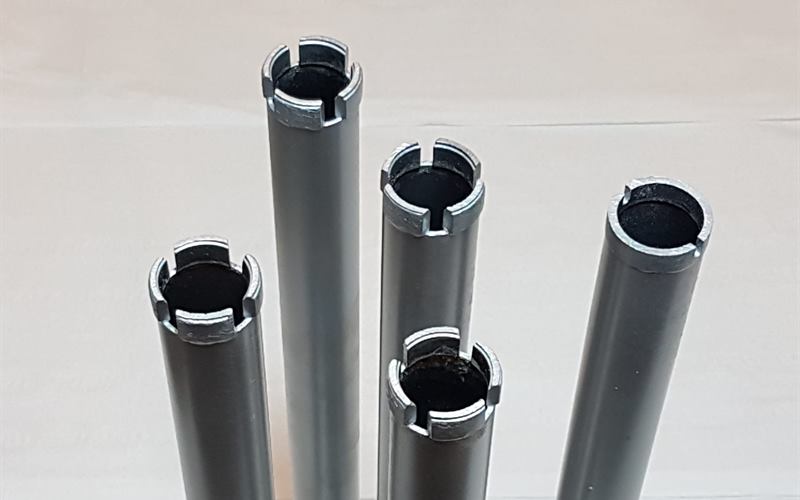
The key points in 30 seconds
- Formula: hole = outside diameter of the element + clearance for sealing (usually 10–20 mm) – and with insulation also 2 × its thickness.
- Boxes: Ø 60 → 68 mm core bit, Ø 80 → 82 mm (dry, M16 + SDS-plus).
- Drainage: DN 50 → 62–72 mm, DN 110 → 122–132 mm, DN 160 → 182 mm.
- Ventilation: Ø 125 → 142 mm, Ø 160 → 182 mm, Ø 200 → 225 mm (without insulation).
- Fire-stopped and watertight penetrations – the diameter from the system documentation, never "by eye".
How do you work out the hole diameter for a service penetration?
The core bit diameter is worked out in three steps:
- Outside diameter of the elementA DN 110 PVC pipe has an outside diameter of 110 mm, a Ø 125 spiral duct – 125 mm. Conduit, protective pipe and insulated duct – measure the outside, including the insulation.
- Clearance for sealingMortar, foam or sealant – usually 10–20 mm more than the element. Sleeve, pipe seal, fire-stop collar – the hole diameter from the system's datasheet.
- The next standard core bit upCore bits are made in a standard series of diameters (e.g. 52, 62, 72, 82, 102, 112, 122, 132, 152, 162, 182, 202, 225 mm). Choose the first one not smaller than the result.
Too tight and too loose – both mistakes cost money. Too small a hole means chiselling, reaming and the risk of damaging the pipe during fitting. Too large – more sealing material, weaker anchoring and an unnecessarily weakened wall or slab, especially in a load-bearing slab or wall.
Boxes, cable penetrations, EV chargers and photovoltaics
| Element | Element diameter | Core bit | Mounting and mode |
|---|---|---|---|
| Electrical box | Ø 60 mm | 68 mm | M16 + SDS-plus, dry |
| Large / junction box | Ø 80 mm | 82 mm | M16 + SDS-plus, dry |
| Cable penetration, conduit | Ø 20–40 mm | 25–52 mm | 1/2" BSP wet or M16 dry |
| EV charger supply, PV cables | protective pipe Ø 32–63 mm | 42–82 mm | 1/2" BSP or 1 1/4" UNC |
Holes for boxes are usually drilled in masonry and plaster – dry, with a core bit with a centre drill on a rotary hammer switched to drilling without hammer action. For cable penetrations what counts is the outside diameter of the protective pipe or conduit, not the cable itself – and when drilling through external walls, leave room for a seal that keeps out water and air.
Which core bit for a drain pipe?
For PVC and PP drain pipes, the DN designation in practice equals the outside diameter – a DN 110 pipe measures 110 mm. With mortar or sealant:
| Pipe | Outside diameter | Hole (10–20 mm clearance) | Core bit |
|---|---|---|---|
| DN 50 | 50 mm | 60–70 mm | 62 or 72 mm |
| DN 75 | 75 mm | 85–95 mm | 92 mm |
| DN 110 | 110 mm | 120–130 mm | 122 or 132 mm |
| DN 160 | 160 mm | 170–180 mm | 182 mm |
| DN 200 | 200 mm | 210–220 mm | 225 mm |
Penetrations through slabs and walls where the pipe moves with temperature (e.g. stacks) are drilled with clearance that allows the pipe to move – and a drain stack through a slab usually needs a fire-stop system anyway. Then the system documentation decides, not this table.
Ventilation and air conditioning – what size hole?
| Duct | Hole (no insulation) | Core bit |
|---|---|---|
| Ø 100 mm | 110–120 mm | 112 mm |
| Ø 125 mm | 135–145 mm | 142 mm |
| Ø 150 mm | 160–170 mm | 162 mm |
| Ø 160 mm | 170–180 mm | 182 mm |
| Ø 200 mm | 210–220 mm | 225 mm |
| Ø 250 mm | 260–270 mm | 300 mm or a made-to-order core bit |
- Insulated duct. Hole = duct diameter + 2 × insulation thickness + clearance. A Ø 160 duct with 50 mm insulation needs about 270 mm – work it out in the calculator.
- Air conditioning (split). The refrigerant pipes, cable and condensate drain usually go through a Ø 65–72 mm hole – a 68 or 72 mm core bit. Drill with a slight fall to the outside so condensate does not run into the wall.
- Heat recovery ventilation and roof outlets. The penetration diameter is given by the manufacturer of the intake, outlet or roof penetration – often with a ready-made mounting sleeve.
Watertight and fire-stopped penetrations – the diameter from the documentation
There are two cases where the "pipe + clearance" table is not enough:
- Fire-stop penetration seals (wraps, collars, intumescent sealants) in fire-separating walls and slabs. The hole diameter and permitted clearance are set by the system's technical documentation for the given pipe and wall or slab – a different clearance can undermine the fire-resistance rating of the penetration.
- Watertight penetrations through foundation walls and tanks – modular seals and wall sleeves. The manufacturer gives the hole diameter for each pipe diameter; the hole is then drilled wet, with an even, smooth wall.
In both cases the core bit is matched to the diameter on the datasheet – in the calculator choose "manufacturer's system" and enter that value. The system is chosen by the building services designer.
Core bit diameter calculator
Choose the element, the sealing method and the wall material. We will work out the minimum hole diameter and match a standard core bit.
Which core drill and thread for which diameter?
| Hole diameter | Typical penetrations | Thread | Machine |
|---|---|---|---|
| up to Ø 62 mm | cables, conduit, anchors, DN 50 | 1/2" BSP or M16 | hand-held core drill |
| 68–102 mm | boxes, air conditioning, EV, DN 75 | M16 + SDS-plus (boxes) or 1 1/4" UNC | rotary hammer without hammer action or core drill |
| 112–250 mm | drainage, ventilation | 1 1/4" UNC | stand-mounted core drill of about 3–4 kW, wet |
| over 250 mm | insulated ducts, process openings | 1 1/4" UNC | high-power core drill on a stand |
Check the thread in the guide how to match a core bit to a core drill, and the machine class in the core drill selector. Reinforced concrete is drilled wet with a core bit with impact-resistant grit – when you hit a bar, reduce the feed pressure and keep the speed constant.
Hole diameters – questions and answers
Which core bit for a 110 drain pipe?
Usually 122 or 132 mm – a DN 110 pipe has an outside diameter of 110 mm, and 10–20 mm of clearance lets you position it and seal it with mortar or sealant. With a sleeve or a pipe seal, the hole diameter is given by the manufacturer.
Which core bit for an electrical box?
A Ø 68 mm core bit for a Ø 60 box and Ø 82 mm for a Ø 80 box. In masonry and lightweight concrete – dry, with an M16 core bit with an SDS-plus adapter and a centre drill.
What size hole for air conditioning?
Usually Ø 65–72 mm for the refrigerant pipes, cable and condensate drain – a 68 or 72 mm core bit. The hole is drilled with a slight fall to the outside so condensate does not run back into the wall.
What size hole for a 125 ventilation duct?
Without insulation usually 142 mm – about 8 mm of clearance on each side for sealing. An insulated duct needs a hole equal to the duct diameter plus twice the insulation thickness and fitting clearance – work it out in the calculator.
How much clearance should be left around a pipe through a wall?
With mortar, foam or sealant – usually 10–20 mm more than the pipe's outside diameter, i.e. about 5–10 mm on each side. Too little clearance makes fitting and sealing difficult; too much needs more material and weakens the wall or slab.
What size hole for a fire-stop or watertight penetration?
The size given in the documentation of the specific system – the manufacturer specifies the hole diameter for each pipe diameter and type of wall or slab. Fire-stopped penetrations and penetrations through foundation walls are never sized by eye.
On this topic: core drilling in concrete
This guide is part of the hub Core drilling in concrete. Related articles and tools:
- How to match a core bit to a core drill – thread chart – UNC, BSP, M16, M14 and adapters.
- Why does a core bit jam? – water, side clearance, drilling square.
- Core bit starter kits – for electricians and installers.
- Core bit configurator – diameter, thread, length and extension.
- For installers – core bits for boxes, drainage and ventilation.
- Core drill speed and bit diameter – an rpm table and a core drill gear calculator.
- Core drilling through thick walls – extensions and cores – a hole deeper than the core bit, with an extension calculator.
- Dry or wet core bit – material, dust and a drilling mode calculator.