Technologist's guide · Core drilling
Core drill speed and bit diameterAn rpm table and gear selection for concrete.
Speed is matched to the peripheral speed of the bit, not “by ear”. For wet drilling in concrete the usual figure is 3–5 m/s at the segment, so the larger the diameter, the lower the gear: Ø 52 mm is about 1100–1840 rpm, Ø 132 mm about 430–720 rpm, Ø 250 mm about 230–380 rpm. The formula: n = 60,000 × v / (π × D). In densely reinforced concrete work in the lower part of the range, and when you hit a bar reduce the feed pressure – the speed should stay constant.
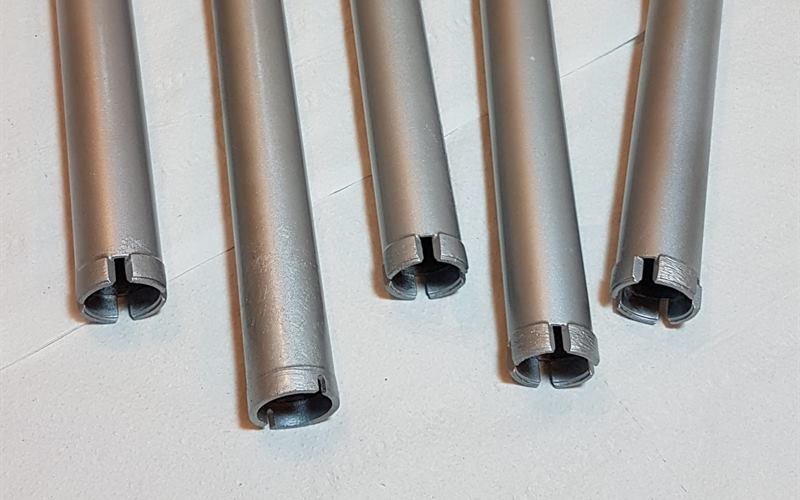
The key points in 30 seconds
- Principle: what counts is the peripheral speed of the segment – about 3–5 m/s in concrete, wet.
- Formula: rpm = 60,000 × v [m/s] / (3.14 × Ø [mm]).
- Small bit – high gear, large bit – low gear: Ø 52 mm about 1100–1840 rpm, Ø 132 mm about 430–720, Ø 250 mm about 230–380.
- Reinforced concrete: lower part of the range, steady water flow, less feed pressure on the bars.
- Change gear with the spindle stopped – never while drilling.
Peripheral speed – why does the gear depend on the diameter?
The diamond cuts concrete at the speed at which the segment moves across the material – this is the peripheral speed, in metres per second. At the same rpm the segment of a Ø 250 mm bit moves almost five times faster than that of a Ø 52 mm bit. That is why core drills have gears, and manufacturers give a diameter range for each of them.
- Formulan [rpm] = 60,000 × v [m/s] / (π × D [mm]). The other way round: v = π × D × n / 60,000.
- ExampleØ 132 mm bit, target 4 m/s: 60,000 × 4 / (3.14 × 132) ≈ 580 rpm. The 3–5 m/s range is about 430–720 rpm.
- Comparing with the drillA gear running at 600 rpm falls within the range – a good choice. A gear running at 1300 rpm would give about 9 m/s, which is clearly too fast.
Why 3–5 m/s? It is an indicative range for wet drilling in concrete and reinforced concrete, used when choosing core drill gears. The exact value for a given bit and bond is given by the tool manufacturer – with hard aggregate and dense rebar you work closer to the lower limit.
Core drill rpm table for 25–500 mm diameters
Speeds calculated from the formula for peripheral speeds of 3, 4 and 5 m/s, rounded to whole revolutions per minute.
| Bit diameter | 3 m/s | 4 m/s | 5 m/s |
|---|---|---|---|
| Ø 25 mm | 2292 | 3056 | 3820 |
| Ø 32 mm | 1790 | 2387 | 2984 |
| Ø 42 mm | 1364 | 1819 | 2274 |
| Ø 52 mm | 1102 | 1469 | 1836 |
| Ø 62 mm | 924 | 1232 | 1540 |
| Ø 72 mm | 796 | 1061 | 1326 |
| Ø 82 mm | 699 | 932 | 1165 |
| Ø 102 mm | 562 | 749 | 936 |
| Ø 112 mm | 512 | 682 | 853 |
| Ø 132 mm | 434 | 579 | 723 |
| Ø 152 mm | 377 | 503 | 628 |
| Ø 162 mm | 354 | 472 | 589 |
| Ø 182 mm | 315 | 420 | 525 |
| Ø 202 mm | 284 | 378 | 473 |
| Ø 250 mm | 229 | 306 | 382 |
| Ø 300 mm | 191 | 255 | 318 |
| Ø 350 mm | 164 | 218 | 273 |
| Ø 400 mm | 143 | 191 | 239 |
| Ø 500 mm | 115 | 153 | 191 |
A core drill rarely hits the middle of the range exactly – choose the gear whose speed lies between the 3 m/s and 5 m/s columns. If no gear fits, a slightly slower gear is better than a faster one. Diameters below Ø 25 mm are usually drilled with high-speed handheld machines, and those above Ø 400 mm with high-power drills in their lowest gear.
Core drill gear calculator
Enter the bit diameter and the gear speeds of your drill from the rating plate or manual. We will show the rpm range, the peripheral speed in each gear and the gear to use.
Drill gears in practice
- Rating-plate speeds are no-load speeds. Under pressure the motor slows down – that is normal. If it slows down noticeably or the overload clutch slips, reduce the feed pressure rather than shifting to a higher gear.
- Change gear with the spindle stopped. Shifting the gearbox under load damages the gears and changes nothing in the drilling itself.
- A low gear also means more torque. A large bit needs force at the spindle – in a high gear the motor stalls and a rig-mounted drill starts to vibrate.
- Handheld drills have their limits. Handheld machines usually have high gears and are meant for smaller diameters. Large bits are drilled with a rig-mounted drill – check the machine class in the core drill selection guide.
- Starting the hole. Drill the first millimetres with light pressure until the segments engage across their full width – the gear stays the same, only the pressure changes.
Too fast or too slow – how can you tell?
| Symptom | Speed too high | Speed too low |
|---|---|---|
| Progress | fast at first, then drops | slow from the start |
| Segments | heat up, wear faster, may glaze | “hammering” action, chipping and broken edges |
| Machine | vibration, motor overload with large diameters | operator pushes harder, risk of jamming rises |
| On rebar | steel heats up and “smears”, the segment loses its sharpness | segment strikes the bar, risk of breakage |
A glazed, smooth segment does not always mean the speed was too high – it can also result from too hard a bond or too little feed pressure. We cover diagnosis by segment appearance in the Problems and wear diagnosis guide, and jamming in the answer why a core bit jams.
Speed and rebar – what to change on the bars?
When the bit hits a bar, the most common mistake is changing gear or pushing harder. Instead:
- Speed stays constantYou choose the gear before drilling. In densely reinforced concrete pick a gear from the lower part of the range from the start.
- Less feed pressureSteel cuts more slowly than concrete – reduce the feed and let the segments work. Too much pressure on a bar is the main cause of segments breaking off.
- Uninterrupted waterA steady flow cools the segment and flushes out the slurry. When it overheats on steel the bond softens and the diamond falls out.
The same applies to cutting with a blade – we explain how segments break off on rebar in the article cutting reinforced concrete without losing segments.
Core drill speed – questions and answers
What rpm for a diamond core bit?
One that gives a peripheral speed of about 3–5 m/s in concrete. The larger the diameter, the lower the speed: Ø 52 mm is about 1100–1840 rpm, Ø 132 mm about 430–720 rpm and Ø 250 mm about 230–380 rpm. Full values are in the rpm table.
How do you calculate core drill rpm for a given diameter?
Revolutions per minute = 60,000 × peripheral speed in m/s / (3.14 × diameter in mm). For a Ø 132 mm bit at 4 m/s this gives about 580 rpm. You can also use the gear calculator.
Which core drill gear for a large diameter?
A lower one. At the same rpm a large bit has a much higher peripheral speed than a small one, and in a low gear the motor also delivers more torque. Change gear only with the spindle stopped.
What happens if the speed is too high?
The segments heat up and wear faster, the bit vibrates and with poor cooling it can glaze or lose a segment. With large diameters too high a gear also overloads the motor.
What happens if the speed is too low?
Progress is slow, the segment “hammers” the material instead of cutting it, and the operator usually pushes harder – which leads to jamming and segments breaking off on the rebar.
Should you change speed when you hit rebar?
Not by changing gear – the speed should stay constant. When the bit meets steel, reduce the feed pressure and keep a steady water flow. In densely reinforced concrete choose a gear in the lower part of the range from the start.
On this topic: core drilling in concrete
This guide is part of the hub Core drilling in concrete. Related articles and tools:
- How to match a core bit to a core drill – thread chart – UNC, BSP, M16, M14 and adapters.
- Hole diameters for building services – electrical boxes, drainage, ventilation and a core bit calculator.
- What speed for a diamond core bit? – the short answer in the hub.
- Core drill selection – power, gears and rig for a diameter range.
- Cutting reinforced concrete without losing segments – pressure, water and bond on rebar.
- Core drilling through thick walls – extensions and cores – a hole deeper than the core bit, with an extension calculator.
- Dry or wet core bit – material, dust and a drilling mode calculator.