Technologist's guide · Core drilling
How to match a core bit to a core drill – thread chartUNC, BSP, M16, M14 and adapters.
A core bit is matched first to the core drill's thread, and only then to the diameter and material. Most wet core drills have a 1 1/4" UNC spindle – core bits for this thread are made from about Ø 32 mm up to 500 mm and more. Small core bits for anchors and penetrations, usually up to Ø 62 mm, have 1/2" BSP, dry core bits for masonry – M16 (also with an SDS-plus adapter for electrical boxes), and porcelain core bits for angle grinders – M14. If you do not know the thread, measure its outside diameter with a caliper: about 31.75 mm is 1 1/4" UNC, about 20.96 mm – 1/2" BSP, 16 mm – M16, 14 mm – M14.
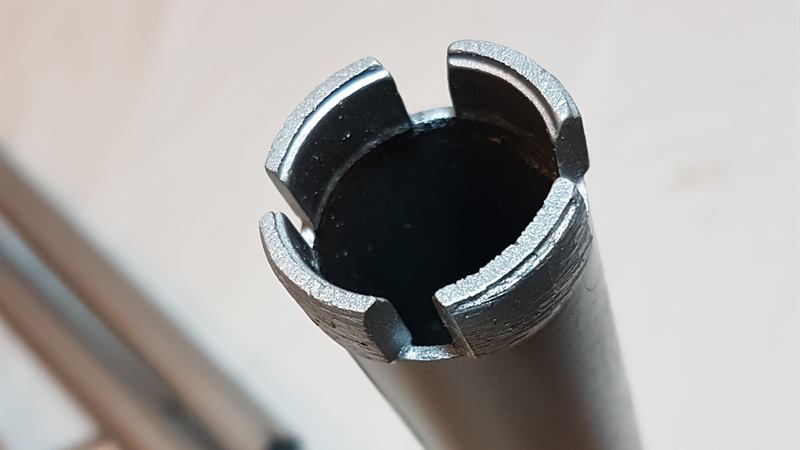
The key points in 30 seconds
- 1 1/4" UNC – the standard on wet core drills, core bits from about Ø 32 mm upwards.
- 1/2" BSP – small core bits, usually Ø 8–62 mm: anchors, cable penetrations.
- M16 – dry core bits for masonry; with an SDS-plus adapter – Ø 68 and 82 mm electrical boxes.
- M14 – angle grinder: porcelain, tiles, stone, usually up to Ø 100 mm.
- Don't know the thread? Measure the outside diameter with a caliper or use the thread identifier.
What threads do diamond core bits have?
On the European market you will find five ways of mounting core bits. Each has its own range of diameters and machines – and none is interchangeable with another without an adapter.
| Mounting | Thread outside diameter | Pitch | Typical core bit Ø | Machine | Cooling |
|---|---|---|---|---|---|
| 1 1/4" UNC | 31.75 mm | 7 threads per inch (3.63 mm) | 32–500 mm and more | core drills on stands and hand-held | wet (also dry) |
| 1/2" BSP (G ½") | 20.96 mm | 14 threads per inch (1.81 mm) | 8–62 mm | hand-held core drills, small drills on stands | wet |
| M16 | 16 mm | 2 mm | 32–162 mm | hand-held dry core drills | dry, with dust extraction |
| M16 + SDS-plus | SDS-plus shank | – | 68 · 82 · 102 mm | rotary hammer (no hammer action) | dry |
| M14 | 14 mm | 2 mm | 6–100 mm | angle grinder | dry or with cooling |
Thread dimensions per the standards: 1 1/4"-7 UNC, G ½ (BSP, 55° thread angle), metric coarse threads M16 and M14. Diameter ranges are typical for the market; specific series are in the core bit finder.
Besides these five, some machine manufacturers use their own quick-change systems. For those an adapter to 1 1/4" UNC is used – system names then serve only to describe compatibility.
How do you check what thread your core drill has?
- Manual and rating plateThe manufacturer states the spindle thread, e.g. "1 1/4" UNC" or "G ½". This is the most reliable source.
- Thread outside diameterMeasure the thread on the spindle with a caliper (or the bore of a core bit you already have): about 31.75 mm – 1 1/4" UNC, about 20.96 mm – 1/2" BSP, 16 mm – M16, 14 mm – M14.
- Pitch at a diameter of about 16 mmCount the threads over 25.4 mm (1 inch): about 12–13 is M16 (2 mm pitch), exactly 11 is 5/8" UNC – the thread used on angle grinders from the US market, not interchangeable with M16.
- Male or female threadThe core bit must have the opposite thread to the spindle. With an adapter – check both ends.
Identify your core drill's thread – online
Enter the measured outside diameter of the thread and choose the machine. We will show the system, matching core bits and what to check before ordering.
Adapter or a core bit with the right thread?
An adapter lets you use one core bit on several machines – and vice versa. Typical combinations are 1/2" BSP ↔ 1 1/4" UNC and M16 ↔ 1 1/4" UNC. But an adapter does not change the drill's power or speed.
An adapter makes sense
- Occasional holes in another systemA few penetrations a month do not justify a separate set of core bits.
- Diameter within the machine's rangeThe drill has power to spare and the right gear for that bit.
- One adapter, never several chainedEvery joint adds length and run-out.
Better the right core bit
- Large diameter on a small machineA small drill with a 1/2" BSP thread will not "pull" a Ø 150 mm bit through an adapter – it will stall and overheat.
- Series workDaily drilling puts constant load on the adapter's threads and risks it working loose.
- Long core bitsAn adapter lengthens the assembly and increases run-out at the crown.
Before wet drilling, coat the thread with copper or technical grease – after working in slurry, the core bit will come off without a long-handled wrench. A damaged, battered thread is replaced together with the end cap during core bit retipping.
The thread is not everything – diameter, power and length
A matching thread only guarantees that the core bit screws on. For it to drill, three more things need to match:
- Diameter and drill power. Ø 150 mm penetrations in reinforced concrete are work for a drill of about 3–4 kW on a stand; a small hand-held drill makes sense up to about Ø 62–82 mm. Check the machine class in the core drill selector.
- Speed. In concrete a bit peripheral speed of about 3–5 m/s is assumed – the larger the diameter, the lower the gear. More: what speed for a core bit.
- Working length. Typically about 450 mm on wet core drills; thicker walls are drilled with an extension of the same thread. The core bit configurator suggests the length and extension.
- Cooling and material. Reinforced concrete – wet, with impact-resistant grit; masonry – dry with dust extraction; porcelain – fine grit. Segment selection rules: bond, concentration, grit size.
The most common mistakes when ordering core bits
- M16 instead of 5/8". Almost the same diameter (16 and 15.88 mm), a different pitch. Grinders and drills from the US market often have 5/8"-11 UNC – an M16 core bit will go on half a turn and ruin both threads.
- 1/2" BSP instead of 1/2" NPT. A similar diameter and 14 threads per inch, but NPT has a 60° angle and is tapered. The joint "sort of holds", but it is not concentric – the core bit runs out.
- "1 1/4 inch" as the hole diameter. 1 1/4" UNC is the size of the mounting thread, not of the hole. The core bit diameter is given separately, in millimetres.
- A dry core bit on a wet core drill – and vice versa. The thread may fit, but the segment does not: a masonry bit quickly loses segments in reinforced concrete, and a "wet" bit overheats when dry.
- A proprietary quick-change system without an adapter. If the drill has a manufacturer's chuck, tell us its name – we will match an adapter to 1 1/4" UNC.
Core bit threads – questions and answers
What thread does a diamond core bit have?
Most often 1 1/4" UNC – the standard on wet core drills for bits from about Ø 32 mm. Small core bits, usually up to Ø 62 mm, have 1/2" BSP, dry core bits for masonry – M16, and porcelain bits for angle grinders – M14.
How do I check what thread my core drill has?
First in the manual or on the rating plate. If it is missing, measure the outside diameter of the spindle thread with a caliper: about 31.75 mm is 1 1/4" UNC, about 20.96 mm is 1/2" BSP, 16 mm is M16, 14 mm is M14. You can also use the online thread identifier.
Are M16 and 5/8" the same thread?
No. They have almost the same diameter (16 and 15.88 mm) but a different pitch and profile – M16 has a 2 mm pitch, 5/8"-11 UNC has 11 threads per inch. Forcing one onto the other ruins both threads.
Can a 1 1/4" UNC core bit be fitted to a drill with a 1/2" BSP thread?
Yes, with a 1/2" BSP to 1 1/4" UNC adapter – but only within the drill's power and speed range. A small drill with a large bit will stall, and the adapter lengthens the assembly and increases run-out.
What thread does a core bit for electrical boxes have?
Usually M16 with an SDS-plus adapter and a centre drill. A Ø 68 mm core bit fits a Ø 60 box, and Ø 82 mm fits a Ø 80 box. Switch the rotary hammer to drilling without hammer action.
Does a 1/2" BSP thread fit 1/2" NPT?
No. BSP has a 55° thread angle, NPT 60°, and NPT is tapered. The diameter and thread count are similar, so they are easy to mix up – the joint will be neither tight nor concentric.
On this topic: core drilling in concrete
This guide is part of the hub Core drilling in concrete. Related answers and tools:
- Which core bit for electrical boxes? – 68 and 82 mm diameters.
- Why does a core bit jam? – water, side clearance, drilling square.
- Core bit configurator – diameter, thread, length and extension in one place.
- Core drill selector – power and speed by diameter.
- For installers – core bit starter kits with the right thread.
- Hole diameters for building services – boxes, drainage, ventilation, with a core bit diameter calculator.
- Core drill speed and bit diameter – an rpm table and a core drill gear calculator.
- Core drilling through thick walls – extensions and cores – a hole deeper than the core bit, with an extension calculator.
- Dry or wet core bit – material, dust and a drilling mode calculator.